

How Performance Marketing Turns Attention Into Action
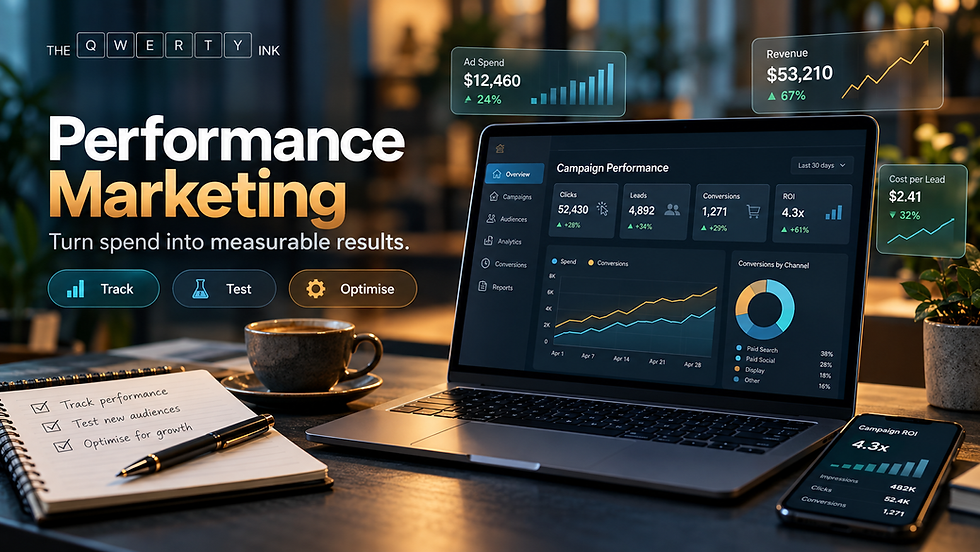
Digital campaigns can generate impressive numbers. Thousands of impressions, hundreds of clicks, and growing website traffic may look positive on a dashboard. But the more important question is: did any of it help the business?
Performance Marketing is a results-focused approach to digital marketing where campaigns are measured against specific actions such as leads, enquiries, purchases, sign-ups, downloads, or other business goals.
For businesses like The QWERTY Ink, this means looking beyond visibility and understanding what happened after someone interacted with a campaign, how much that result cost, and whether it was worth the investment.
In simple terms, it connects marketing spend with measurable outcomes.
A Click Is Only the Beginning
Getting someone to click an advertisement does not automatically make the campaign successful.
Imagine two campaigns. One generates 1,000 clicks but almost no enquiries. Another generates only 300 clicks but brings in customers who actually buy.
Which one performed better?
That is why Performance Marketing looks beyond attention and considers what happens next.
Useful indicators can include:
Conversion rate – How many visitors complete the intended action?
Cost per acquisition – What does it cost to gain a customer?
Return on ad spend – What value is generated against advertising spend?
Lead quality – Are the enquiries actually relevant?
Customer actions – What happens after someone reaches the website?
The best-looking number is not always the most useful one.
How The QWERTY Ink Approaches Performance Marketing
At The QWERTY Ink, the process begins by understanding what the campaign is actually expected to achieve.
A campaign created for awareness should not be judged in the same way as one designed to generate leads or purchases. The business goal determines what needs to be measured.
From there, the approach looks at the complete journey:
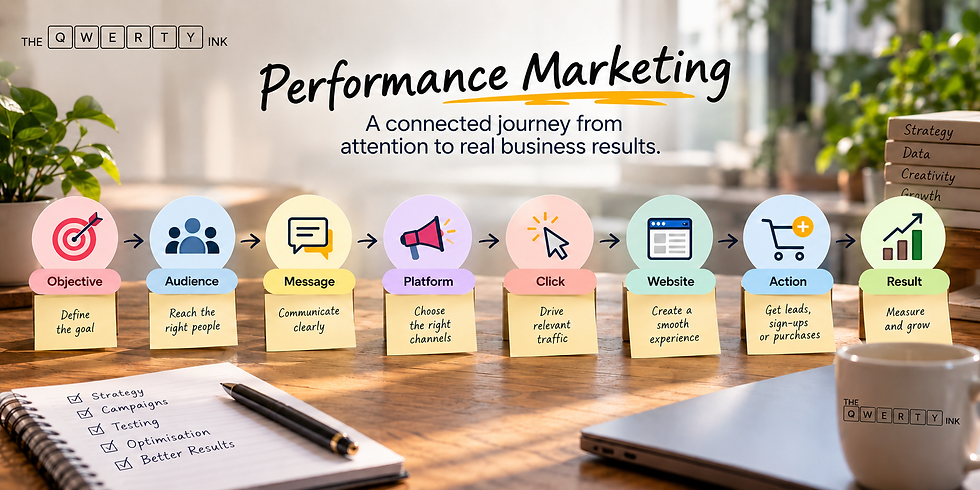
Objective → Audience → Message → Platform → Click → Website → Action → Result
Performance Marketing therefore becomes more than running advertisements. It connects campaign execution with data interpretation, customer behaviour, website experience, and wider business objectives.
The purpose is to identify what is working and make the next decision with better information.
The Cheapest Lead Can Still Be Expensive
A low-cost lead may look impressive until none of those leads convert.
Similarly, a campaign with a higher acquisition cost may still be valuable if it attracts customers who purchase more, stay longer, or fit the business better.
Performance needs context.
Businesses should therefore ask not only “How much did this lead cost?” but also “What happened after we got it?”
That question can prevent businesses from optimising for attractive dashboard numbers while missing the result that actually matters.
Final Thoughts
Performance Marketing makes digital marketing more accountable by connecting activity with outcomes.
Its real advantage is not simply that everything can be measured. It is that those measurements can reveal what deserves more investment, what needs improvement, and what should stop consuming budget.
Better campaigns are rarely built from one perfect idea. They are built by paying attention to what the results are saying.
Turn campaign activity into measurable progress. Explore The QWERTY Ink and build digital strategies around results that matter.


Comments